

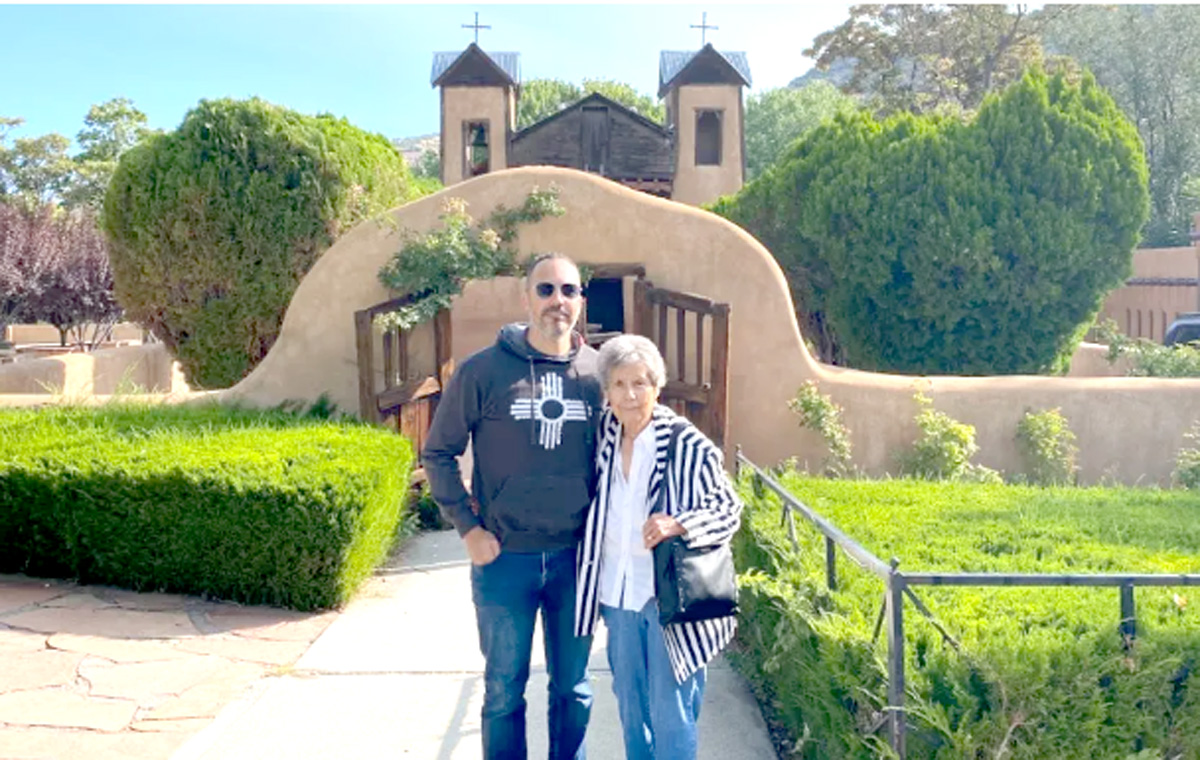
For Jeremy Jojola, understanding New Mexico’s history has never been just about genealogy, it’s about connecting with the roots that shaped who he is today.
This summer, the award-winning journalist behind Cuentos y Corazón, a social media storytelling project inspired by his New Mexico roots, will speak at the 2026 Genealogical Society of Hispanic America Conference in Taos, where heritage, history and identity take center stage.
Jojola, a 23-time Emmy Award winner, two-time Edward R. Murrow Award recipient and 2026 Journalist of the Year as named by the Society of Professional Journalists, will appear at the conference from June 26-28. His presentation will focus on identity, ancestry and the importance of preserving family stories before they disappear.
For Jojola, those stories begin with his own family.
Born in Las Cruces, and raised in Reno, Nevada, Jojola had a unique childhood experience with New Mexico, where every summer he returned to San Jose, a small village near Las Vegas, New Mexico, where his grandparents lived. Those summers were surrounded by family, traditions, food and the distinct Spanish dialect of northern New Mexico which shaped his sense of home.
“I’ve always felt New Mexico has been my stable home, the place where I feel the most centered,” Jojola said in an interview with the Questa del Rio News.
His family history reflects the layered and often untold history of New Mexico itself.
Jojola’s father was born in Santa Fe and adopted at just 3 days old by Manuel Jojola, a Native American medicine man from Isleta Pueblo. Raised in Pueblo culture, his father later learned he had been adopted, a revelation that reshaped his understanding of identity while still remaining deeply rooted in indio-hispano traditions that make up the unique, yet complex identity of northern New Mexico.
When Jojola was 5, his father located his biological family in the Santa Rosa, Anton Chico and Puerto de Luna areas. Through those connections, Jojola discovered generations of ranching families whose roots stretched back centuries and reflected the blending of Indigenous, Spanish and European ancestry that defines much of New Mexico.
“That’s when I started understanding how complex our history really is,” Jojola said.
Growing up in predominantly Anglo schools and neighborhoods outside the state, Jojola often struggled to understand where he fit.
In fourth grade, he remembers being taught that Hispanic New Mexicans were simply descendants of Spanish conquistadors. But the more he researched his own family, the more he realized the reality was far more complex.
“I found out that wasn’t the simple truth,” he said. “There were Indigenous roots, mixing of cultures, complicated histories and stories people sometimes kept hidden because of shame or social pressures.”
That search for identity eventually became “Cuentos y Corazon,” a storytelling project he launched last year to explore New Mexican culture, language and ancestry through a deeply personal lens.
The response, he said, was overwhelming.
Within months, people across New Mexico began sharing their own stories of identity, family history and cultural loss.
“A lot of us grew up feeling like outsiders in our own story when we didn’t fully relate to Mexican Americans or Native Americans,” Jojola said.
Through his work, he hopes New Mexicans embrace the fullness of who they are instead of reducing themselves to simplified labels.
He believes generations of New Mexicans have hidden parts of their histories, Indigenous ancestry, cultural mixing and difficult family stories with Spaniard descendants, because of shame, assimilation or outside definitions imposed on them.
“Our history isn’t compartmentalized,” Jojola said. “We are all these different backgrounds, traditions and belief systems coming together. That’s what makes New Mexico special.”
One of Jojola’s deepest passions is preserving oral history.
He encourages families to interview grandparents and elders, record conversations and document the traditions and language that have been passed down for generations.
“I wish with all my heart I had recorded my grandmother more,” he said. “Record them. Listen to them. Hold them. Document your family histories now before it’s gone when they pass away.”
Jojola also hopes to preserve New Mexican Spanish, a centuries-old regional dialect shaped by Spanish, Indigenous and local traditions. He often carries a dictionary of New Mexico and southern Colorado Spanish and worries the language could fade if younger generations do not continue speaking and documenting it.
“I don’t know if it can fully come back,” he said, “but I want people to understand it and appreciate it.”
Although Jojola has spoken to genealogy and cultural groups before, the Taos conference will mark his first major genealogy conference appearance.
“I’m honored they asked me to speak,” he said. “I want to share the importance of storytelling and why understanding our roots matters.”
Additional speakers include son of Questa Dr. Estevan Rael-Gálvez, former New Mexico State Historian and director of Native Bound Unbound, who will present on Indigenous histories of captivity and enslavement; historian Richard Melzer, who will discuss New Mexico history through significant museum artifacts; and Jonathan Pringle and Dena Hunt of the New Mexico State Archives, who will lead presentations focused on archival treasures and genealogical research.
The conference will also feature Taoseña educator and multimedia artist Juanita Jaramillo Lavadie, who will speak on the history of ciboleros, or buffalo hunters of northern New Mexico, and longtime genealogist Antonette Gonzales, whose presentation will explore family origins and identity.
Other featured speakers include Professor Emeritus and Deacon Larry Torres, an educator, historian and author known for his work on New Mexican culture and religion; poet Karen S. Córdova, whose writing reflects the Hispano experience of the Southwest; and Taos poet and storyteller Olivia Romo, whose work centers on land, water, culture and community in northern New Mexico.
Organizers say the conference aims to bring together conversations on genealogy, cultural identity, oral history and the preservation of New Mexico’s rich and layered heritage
Genealogical Society of Hispanic America Conference
June 26-28, 2026
Sagebrush Inn and Suites
Prices vary from $75- $195
Register online.
https://www.gshaa.org/event-details/gsha-2026-conference-taos-nm