

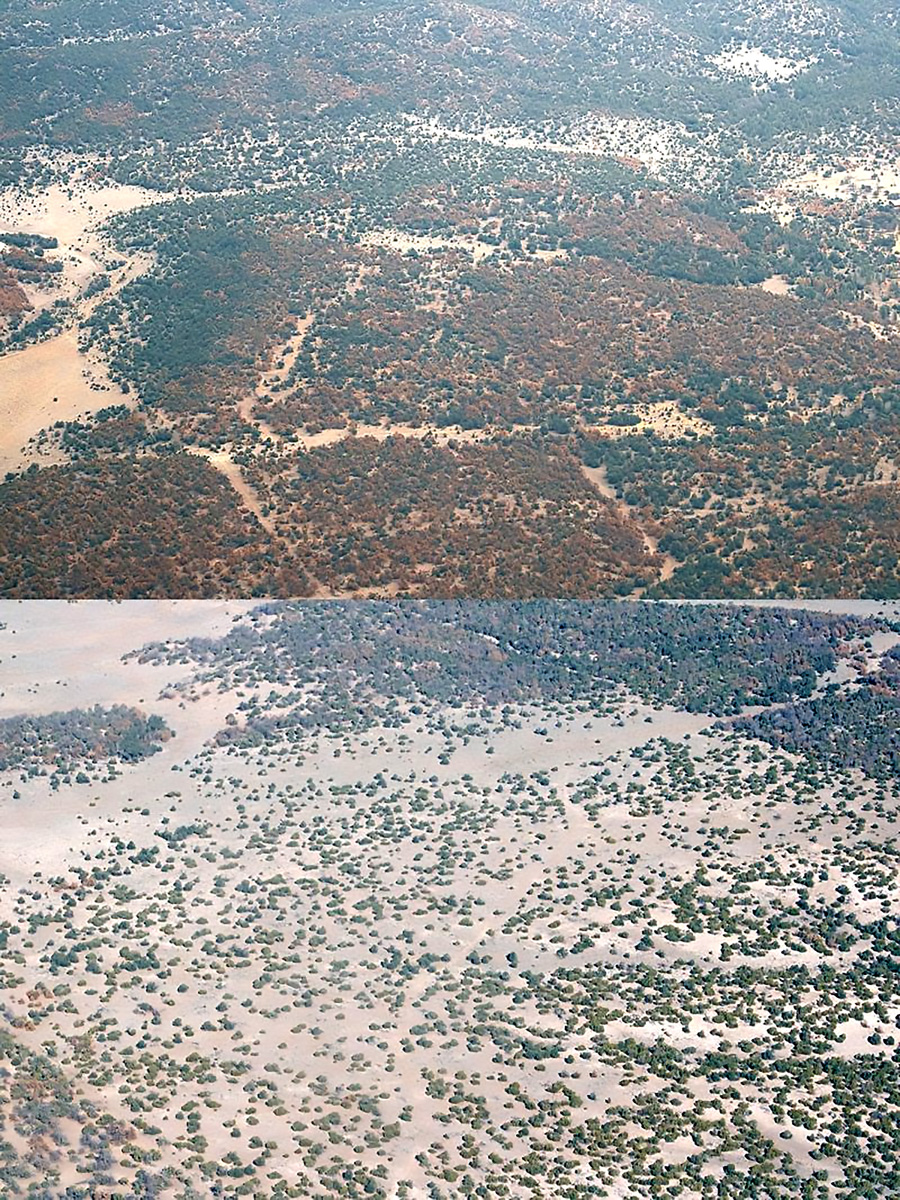
Tree mortality across New Mexico tripled in 2025 as drought and heat continued to stress forests statewide, according to a new forest health report released by state and federal officials.
The annual survey, conducted by the New Mexico Forestry Division and the U.S. Forest Service, examined approximately 14 million acres of state, private, Tribal and federal forests and woodlands. The report found a sharp increase in insect-related tree deaths during what was the state’s second-warmest year on record.
Beetle-killed conifer forests increased by 211% compared with the previous year, with most of the damage occurring on national forest lands. Areas impacted by drought and heat rose 66%, while overall acreage showing some form of forest damage declined 6%. Defoliation, or the loss of leaves and needles that does not necessarily result in tree death, decreased 51%.
State Forester Laura McCarthy said the findings provide a snapshot of current forest conditions but also offer insight into future trends.
“It’s important to contextualize that this report is a snapshot of New Mexico’s forests at a specific time,” McCarthy said in a statement. “However, this snapshot is a good predictor of what to expect for the next few years if such meager precipitation and warm winter temperatures persist.”
Forest health experts say the increase in mortality reflects a combination of prolonged drought, rising temperatures and overcrowded forest conditions that leave trees more vulnerable to insect attacks.
“Bark beetles are a natural check on forest density, but warm winter temperatures are extending their activity, and overly dense, drought-stressed forests are a buffet for these insects,” said Victor Lucero, the state’s forest health program manager.
Lucero noted that while widespread tree deaths can dramatically alter landscapes, surviving trees often remain within affected areas and help forests regenerate over time. Similar recovery has been observed in regions impacted by severe piñon pine mortality in the early 2000s, when some areas lost as much as 80% of their piñon trees.
Officials said mortality events can temporarily increase wildfire risk, although that risk generally declines after dead needles fall from affected trees. They also emphasized that dead trees play an important ecological role by stabilizing soils and returning nutrients to the ecosystem.
“Our forests have exceeded the land’s carrying capacity,” Lucero said. “No matter what, disturbance events will try to rebalance our ecosystems, whether it’s through human intervention, like proactive thinning, or biological events such as pest outbreaks or wildfire.”
State officials are also investing in long-term restoration efforts. Earlier this year, New Mexico and university partners broke ground on the New Mexico Reforestation Center, which is expected to expand production of climate-adapted seedlings for forest restoration projects across the state.
The report and an accompanying forest health dashboard provide a detailed overview of insect activity, disease impacts and environmental stressors affecting New Mexico forests during 2025.