

On Sept. 3, a federal judge heard roughly four hours of arguments over a lawsuit challenging the environmental review and federal financing of a proposed $95.6 million green hydrogen facility in Questa, then took the matter under advisement.
U.S. District Judge David H. Urias did not issue a ruling at the hearing. He said he would review the documents filed in the case before deciding whether to grant the plaintiffs’ request for an injunction that could halt work on the project.
The lawsuit was filed by the Cabresto Lake Irrigation Community Ditch Association and the Acequia Madre del Cerro de Guadalupe against the U.S. Department of Agriculture’s Rural Utilities Service. The associations argue that the federal environmental review was inadequate and failed to fully examine potential effects on groundwater and other regional water resources.
Urias previously denied an emergency request to immediately halt the project, finding that the plaintiffs had not demonstrated the immediate and permanent environmental harm necessary for that relief. The denial did not resolve the underlying claims in the lawsuit. A preliminary injunction hearing was subsequently scheduled for Sept. 3.
At the hearing, the court considered documents and arguments concerning the federal agency’s environmental review, the project’s proposed water use, its location on property associated with the former Chevron Questa Mine and the terms under which Kit Carson Electric Cooperative would occupy the site.
One document before the court was a declaration signed Aug. 18 by Christopher McLean, an assistant administrator with USDA Rural Utilities Service (RUS). The declaration, filed Aug. 19, describes the status of the federal financing and steps KCEC must complete before the loan can close.
The case also involves a letter of interest that KCEC submitted to RUS. The letter was the basis for RUS inviting the cooperative to submit a formal funding application under a structure consisting of an 80% loan and 20% grant, according to the documents described in court.
Another issue discussed was KCEC’s control of the project site.
KCEC and Chevron signed a three-year lease for the property in May 2026. The lease differs from the arrangement contemplated in earlier federal project documents, which had anticipated KCEC purchasing the property from Chevron. The lease runs through May 2029, according to court filings.
During the hearing, an attorney for RUS told the court that KCEC would need either a 30-year lease or ownership of the property because the land is intended to serve as collateral for the federal loan.
The lease issue is significant because the proposed hydrogen facility is expected to operate beyond the term of the current three-year agreement. The plaintiffs argue that the federal government should have reconsidered its environmental review after the lease was executed because the final terms affected questions of site control, ownership and environmental responsibility. Those claims remain disputed and have not been resolved by the court.
Water is another central issue in the lawsuit.
The proposed project would use groundwater from an existing Chevron well known as POD 18. The plaintiffs contend that the federal environmental assessment did not adequately analyze potential effects of sustained groundwater pumping on nearby wells, surface water and acequia water rights.
KCEC and its consultants have said the project would use substantially less water than the well’s maximum permitted capacity. According to previously published information about the project, KCEC estimates operational use at about 47 acre-feet per year, while the well has a permitted capacity of up to 250 acre-feet annually.
The lawsuit also challenges the scope and timing of the federal environmental review. The plaintiffs contend that the review did not adequately consider the proposed solar array as part of a connected project. Their challenge also includes the timing of assessments addressing potential environmental effects on health, safety, water, wildlife and vegetation.
According to the attorney representing the plaintiffs, those recommended assessments were not completed until after USDA’s Rural Utilities Service issued its Finding of No Significant Impact, or FONSI.
The plaintiffs argue that the timing of those assessments meant RUS made its decision without having all of the relevant environmental information before it when it issued the FONSI. They contend that this constituted a violation of the National Environmental Policy Act, or NEPA. Those claims are disputed and have not been resolved by the court.
The proposed hydrogen facility is planned on property associated with the former Questa Mine and the federal Superfund cleanup site, adding another layer to the environmental questions before the court. Although the the solar arrays and proposed hydrogen plant sit within the Superfund boundary, they are not on top of mine tailings according to recent EPA meeting.
USDA previously issued a Finding of No Significant Impact based on an Environmental Assessment of the project. Federal officials concluded that the project would not have significant environmental effects requiring a full Environmental Impact Statement. The plaintiffs challenge that conclusion and argue that the federal review was incomplete.
The broader KCEC initiative has received a $231 million New ERA investment from USDA for hydrogen and solar facilities with battery storage in rural New Mexico. USDA has described the initiative as a project intended to provide renewable energy and improve reliability for KCEC members.
The legal challenge has added to growing local opposition and debate over the project, particularly concerning groundwater use and construction near the former tailings site.
Kit Carson Electric Cooperative CEO Luis Reyes said the cooperative intends to continue engaging with the community while moving the project forward.
“We know there is a lot happening around this project, but our focus at Kit Carson remains on moving forward responsibly, listening to our community and doing the work that is in front of us. Over the past several months, we have made a significant effort to provide more information, answer questions and make the technical work behind this project easier for people to understand. We have also heard directly from community members who have thanked us for that outreach and encouraged us to continue the conversation. That matters to us. Questa is a community with a proud history and people who care deeply about its future. We respect that people have questions and different perspectives, and we will continue working with community leaders, residents and technical experts as the project progresses,” said Kit Carson Electric Cooperative CEO Luis Reyes. “There is still work ahead, but there is also real progress being made. Kit Carson remains committed to showing up, sharing information and working positively with the people of Questa toward a stronger and more resilient future for the community.”
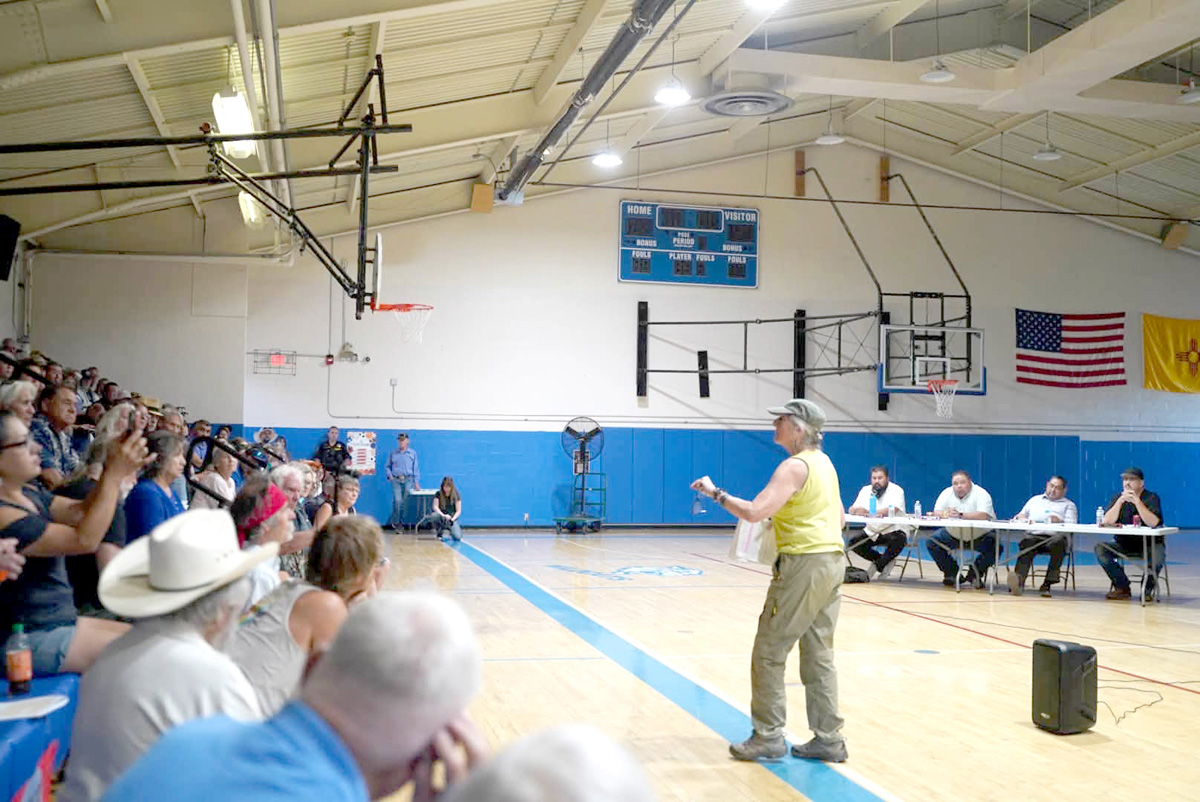
At a Sept. 10 special meeting of the Village of Questa Council held at Alta Vista Intermediate School, people were removed by police after a heated exchange with Village of Questa attorney Marcus Rael. Rael contends this is a federal issue, and the municipality has very little power to stop the project from proceeding.
For now, however, the federal case remains unresolved.
U.S. District Judge Urias has taken the matter under advisement and has not announced when he will issue a decision. The Sept. 3 hearing did not constitute a ruling on whether USDA violated federal environmental law, whether the project can proceed, or whether a more extensive environmental review will be required.