

The proposed green hydrogen plant in Questa has moved from a conceptual clean-energy project to a focal point of intense local debate regarding water security and local government transparency.
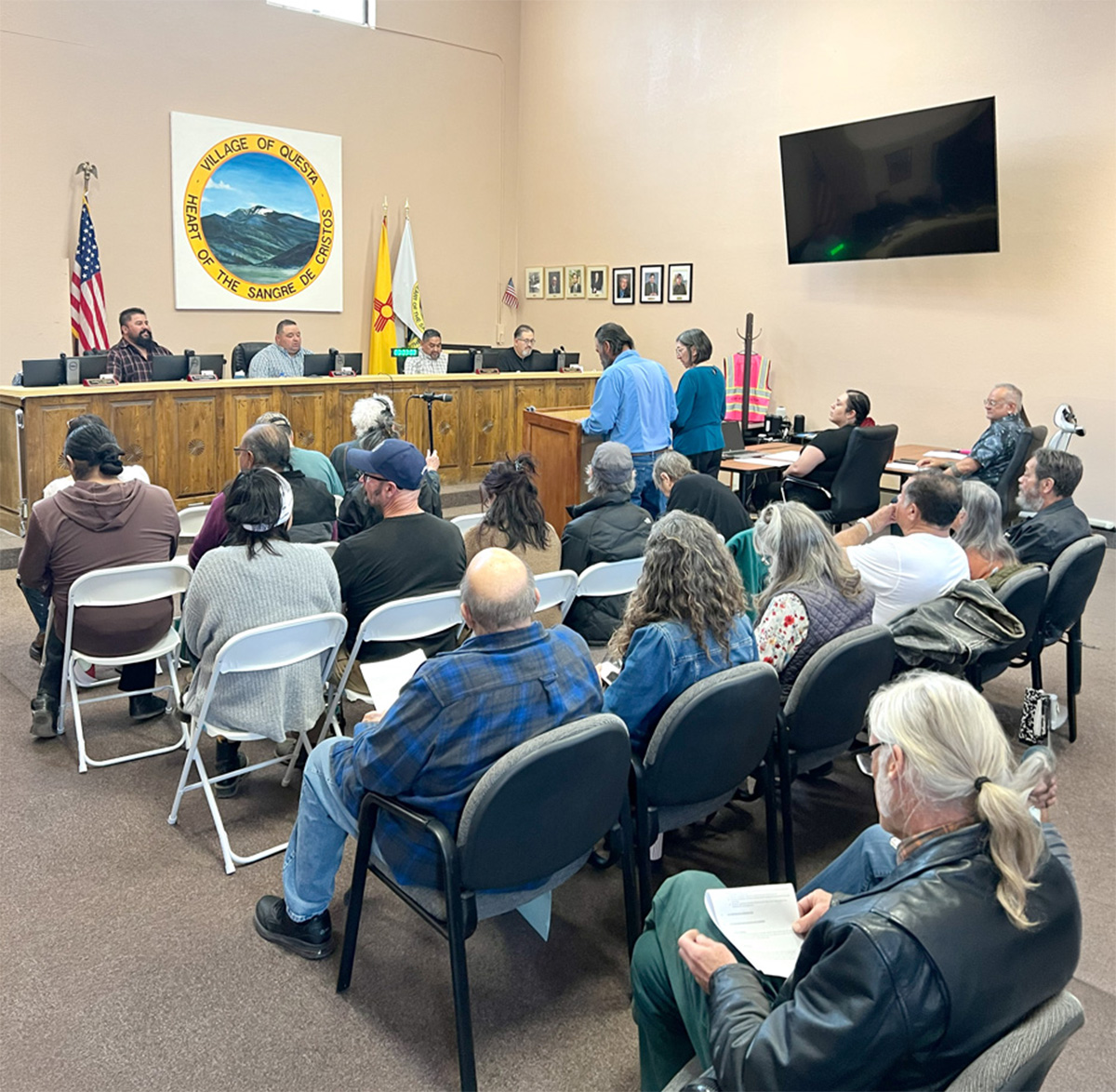
During a packed Village Council meeting on March 10, and a subsequent gathering of the Questa Watershed Protectors on March 15 at the Questa VFW, residents and elected officials alike raised pointed questions about the project’s evolving technical specs and its reliance on a tailings-well owned by Chevron.
The $231 million Green Hydrogen project, a collaboration between the Village and Kit Carson Electric Cooperative (KCEC), aims to provide long-duration energy storage. However, a shift in federal regulations under the National Environmental Policy Act (NEPA) has expedited the process and completed the Environmental Assessment (EA) in January of 2026, leading some community members to feel sidelined.
At the heart of the opposition is the source of the water. Initially presented as using treated mine water, the plan now involves a tailings well west of town. At the March 15 meeting of the Watershed Protectors, Cabresto Lake Irrigation Community Ditch Association Chairman Danny Garcia noted the well was originally intended for dust abatement.
While Kit Carson Electric and its consultants emphasize that the facility will use a deep well protected by thick clay layers, many residents remain skeptical. Locals point to a 2018 study showing a small but steady decline of 0.14 feet per year of the aquifer, raising concerns that any new industrial draw—regardless of its depth—could further strain a resource already impacted by decades of drought.
| The Issue | Watershed Protectors Perspective | Kit Carson Electric (KCEC) Perspective | Village of Questa (VOQ) Perspective |
| Water Usage | Fear that pumping 47 acre-feet/year from the tailings well will deplete the aquifer and dry up domestic wells and acequias. | Plans to use existing Chevron water rights. The well is adjudicated for 250 acre-feet/year as approved by Office of State Engineer in 2016; 2025 usage was 5.36 acre-feet used for dust abatement. Planned usage not to exceed 47 acre-feet/year. Would use wastewater if it became available. | Focused on ensuring no water is taken from the existing municipal supply. Notes additional water impairment study is forthcoming. |
| Safety & Risk | Concerns over high-pressure storage of flammable hydrogen near Alta Vista elementary school and community. | Asserts all federal safety standards will be met with 24/7 monitoring and modern secondary containment systems. A third-party safety evaluation was conducted by Baker Risk Feb. 2026. | Focused on ensuring no water is taken from the existing municipal supply. Notes additional water Relies on state and federal environmental impact studies and Finding of No Significant Impact (FONSI) from EA (signed Jan. 2026) |
| Economy & Jobs | Questions if the “boom” of 150-250 temporary construction jobs and 9-10 long term jobs will lead to meaningful, local employment. | Views the $>200 million total investment as a way to stabilize the grid by providing up to 50 hours or more of backup power through energy storage. This would involve a Power Purchase Agreement with the VOQ valued at a minimum of $1 million per year for 20 years. | Sees the project as a vital new tax base to replace lost revenue from the 2014 Chevron mine closure. |
| Transparency | Critical of “backroom” research into private LLCs (Questa Solar 1) and a perceived lack of formal public Q&A sessions. | States the public-private partnership is a legal necessity for the Village to eventually own the solar infrastructure. | The Mayor maintains that research into legal partnerships does not require prior council approval but will be voted on publicly. |
| Federal Oversight | Concerned that “fast-tracked” NEPA rules under the USDA eliminate the study of long-term cumulative environmental risks and halted public comment during the planning phase. | Emphasizes strict compliance with the current federal regulations and FONSI. Public comments were taken during the scoping process and subsequent meetings. | Trusts the federal process to vet the site while prioritizing the June 2026 groundbreaking to secure project funding. |
The Cabresto Ditch Association is concerned about water availability based on evidence of reduced surface water runoff over the past few decades. However, proponents state that water pulled from the proposed well will not effect surface water flow. A 2016 impairment study conducted by the Office of the State Engineer (OSE), approved Chevron’s use of this well for up to 250 acre-feet per year. A new impairment study will need to be completed as part of the water lease agreement for KCEC’s use of 47 acre-feet per year out of the allocated 250 acre-feet.
There are two technically and financially distinct components of the proposed projects; solar and green hydrogen. The solar array acts as the primary power generator. This 50-megawatt field of panels is designed to capture sunlight for electricity. Under the current proposal, the Village would eventually own this entity, potentially generating approximately $1.5 million in annual revenue.
In contrast, the green hydrogen facility functions strictly as a long-duration storage system, essentially acting as a high-capacity battery. This facility uses solar power to run electrolyzers that split water into hydrogen gas for storage in tanks. That gas is then converted back into electricity via fuel cells during outages or at night, providing up to 50-hours of back-up power. While the solar panels rely on land and sunlight, the hydrogen facility is the component requiring the controversial 47 acre-feet of water annually.
Critics of the project have pointed to efficiency concerns, noting that the conversion process results in roughly a 40% return of the original energy. Proponents argue, however, that 40% efficiency is superior to losing 100% of the “excess” solar power generated during peak daylight hours when the grid cannot currently absorb it. By capturing this otherwise wasted energy, the plant functions as a strategic reservoir, ensuring that 40% of that power remains available for later use rather than being lost entirely.
While a formal federal comment period is not required under new regulations, a state-level legal window will open once the water transfer (Chevron to KCEC) application is filed. This will allow residents a 30-day period to file formal protests. Public meetings have been held by all stakeholders in recent months regarding information about the project.
The March 10 Village council meeting saw Councilmen Jason Gonzalez and Daryl Ortega question the Mayor regarding a January telephone conference involving research into a public-private partnership with KCEC. Councilman Ortega questioned why the council was not informed of the research into “Questa Solar 1 LLC.” In response to these concerns, the Watershed Protectors confirmed they have filed an informal complaint with the State Ethics Commission, alleging a conflict of interest for the Mayor.
The project is racing against a July 4, 2026 deadline to qualify for a 50% tax credit under the Inflation Reduction Act. To meet this, a June groundbreaking of the Solar Array project is planned. For the Village of Questa, the Solar project represents a a $50 million ($25 million in grant funds awarded mid-March and approximately $25 million in tax credits)investment intended to stabilize energy costs and restore a dwindling tax base.

Proposed location of the Solar Array project from the Vistas trail, looking east into Questa, taken March 13
