

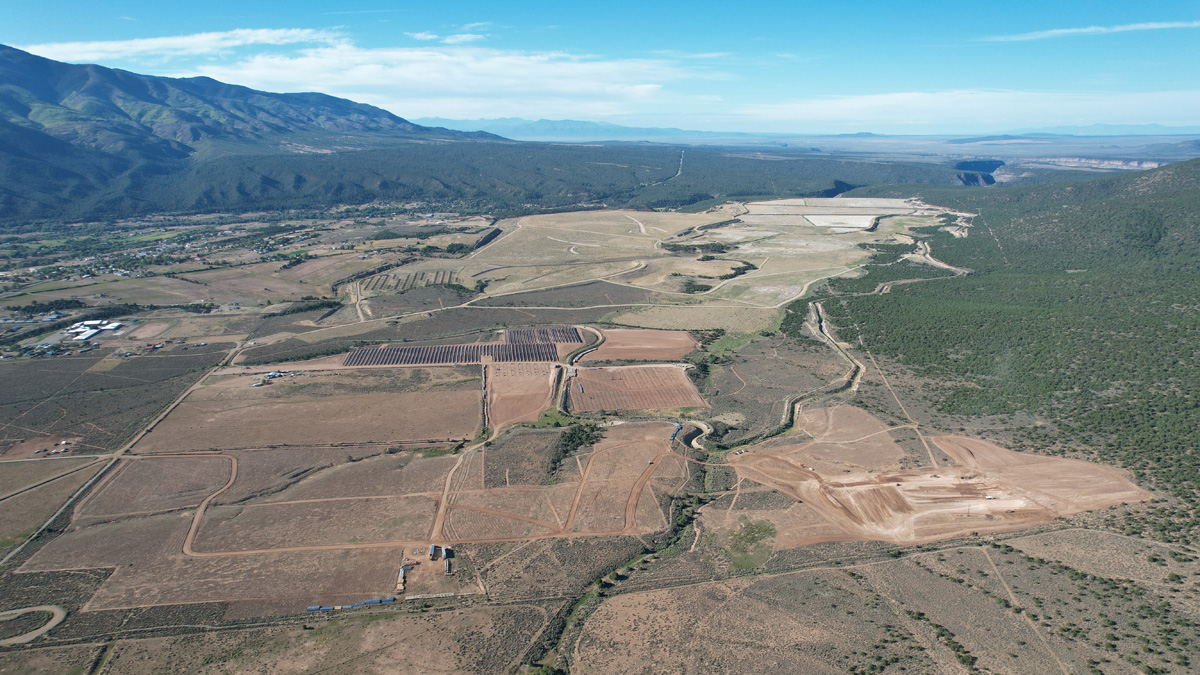
A major legal challenge has been filed over the proposed green hydrogen facility and solar array in the Village of Questa. On August 7, 2026, two local ditch associations—the Cabresto Lake Irrigation Community Ditch Association and the Acequia Madre del Cerro de Guadalupe—filed a lawsuit in federal court in Albuquerque against the U.S. Department of Agriculture Rural Utilities Service. Representing hundreds of local parciantes, the acequias are asking a federal judge to pause project activities and order a more thorough environmental review before construction proceeds.
As a recent update to the court filing, on August 19, Judge David H. Urias denied the plaintiffs’ emergency request to halt the project due to failure to prove immediate, permanent environmental harm. While construction and funding may proceed, a preliminary injunction hearing is scheduled for September 3, 2026.
The dispute stems back to January 2026, when the federal agency adopted a preliminary Environmental Assessment (EA) contracted by Kit Carson Electric and completed by Entrust, and issued a “Finding of No Significant Impact.” That determination meant federal officials believed the project would cause no major environmental harm. However, attorneys representing the acequias argue that review was rushed, incomplete, and conducted without providing a meaningful opportunity for public input or community notice before federal approval was granted. They contend the government should have conducted a full Environmental Impact Statement, a much more detailed analysis, to thoroughly weigh potential risks to regional water supplies and public safety.
In their court filing, the acequia associations point to several central concerns. First, they raise flags over potential water consumption. The lawsuit highlights capacity figures from the EA, indicating the facility could draw groundwater from an existing Chevron mine well west of town (POD 18) at rates up to roughly 10,579 gallons per hour. That peak hourly rate corresponds to running the well at its maximum permitted limit of 250 acre-feet per year (over 81 million gallons annually). Because electrolyzers split liquid water into hydrogen and oxygen gas, that water undergoes complete chemical destruction and is permanently removed from the local water table rather than returned to the aquifer. The lawsuit argues the federal government failed to model how sustained pumping at full permitted capacity could affect nearby private wells, surface streams, or historical acequia rights because the EA concludes that groundwater resources will not be affected and impacts are negligible.
Kit Carson Electric and technical consultants emphasize that actual operations will use only a fraction of that maximum limit. Kit Carson Electric Cooperative and its technical consultants note that the Chevron well draws from a deep aquifer protected by thick clay layers and that the water is deemed non-potable. While the well retains its legal mining permit for up to 250 acre-feet annually, KCEC maintains that because the plant operates intermittently alongside solar power generation, its proposed operational usage is capped at roughly 47 acre-feet per year (about 15.3 million gallons annually, or under 2,000 gallons per hour on average).
The lawsuit also claims federal reviewers improperly split up the project by analyzing the hydrogen plant while excluding the accompanying 200-acre solar array from the environmental review due to separate funding sources. Furthermore, plaintiffs raise environmental concerns regarding the project’s location directly within the Tailings Area of the Chevron Questa Mine Superfund site. The lawsuit notes that ongoing site preparation and excavation risk disturbing contaminated soil and interfering with existing remedial containment systems.
Questions surrounding land control are also central to the complaint. According to court records, while initial federal approvals assumed KCEC would purchase the property from Chevron, KCEC and Chevron instead executed a three-year lease on May 8, 2026, running through May 2029. The lawsuit points out that with plant operations expected to begin in 2028, KCEC would have only one year of operation under the current lease terms. Because this agreement was signed five months after federal officials issued their environmental decision, the plaintiffs argue the federal government violated procedure by failing to reopen its review to evaluate how the lease impacts long-term site control, groundwater authority, and liability for environmental remediation.
Finally, the complaint stresses safety concerns surrounding plans to store up to 29 tons of pressurized hydrogen gas across 54 tanks, citing a project hazard evaluation where 27 out of 79 hypothetical failure scenarios involved loss of containment or explosion risks.
KCEC maintains that independent safety evaluations have thoroughly examined potential failure scenarios, and that the site will feature modern monitoring, automated shut-offs, and strict industrial safety controls. The plaintiffs in the case assert that the safety study was not independent because Questa Mayor John Ortega was the lead on the study and say that it’s not independent due to the conflict of interest. Additionally, they allege that the USDA failed to independently verify the study along with major studies including groundwater impacts, Superfund site risks, and project safety. When inquired, we discovered Mayor John Ortega didn’t lead or prepare the safety study but was listed as a participant in the study. Participants in the safety analysis include Entrust, personnel from KCEC, as well as personnel from the Sandia National Lab. Ultimately, sponsors emphasize that the $231 million project is designed to store excess solar energy as hydrogen fuel, strengthening local microgrids during power outages and helping northern New Mexico achieve reliable, year-round clean energy.
Questa del Rio News will continue to cover developments as the judge considers the request. As of press time, representatives from KCEC stated that they cannot comment on the court filing specifically while the lawsuit remains pending.
*Questa del Rio News is a nonprofit organization dedicated to providing unbiased and fair media coverage. While we are a small publication, we take our responsibility to accuracy and thorough reporting seriously. As part of our due diligence, this story was reviewed by both parties involved in the case to ensure that our interpretation of the facts was accurate and fair. Both parties were also given the opportunity to provide input and respond to the information presented. Ultimately, the story was published at the discretion of the Questa del Rio News, with fairness, transparency, and accountability as our guiding principles.