


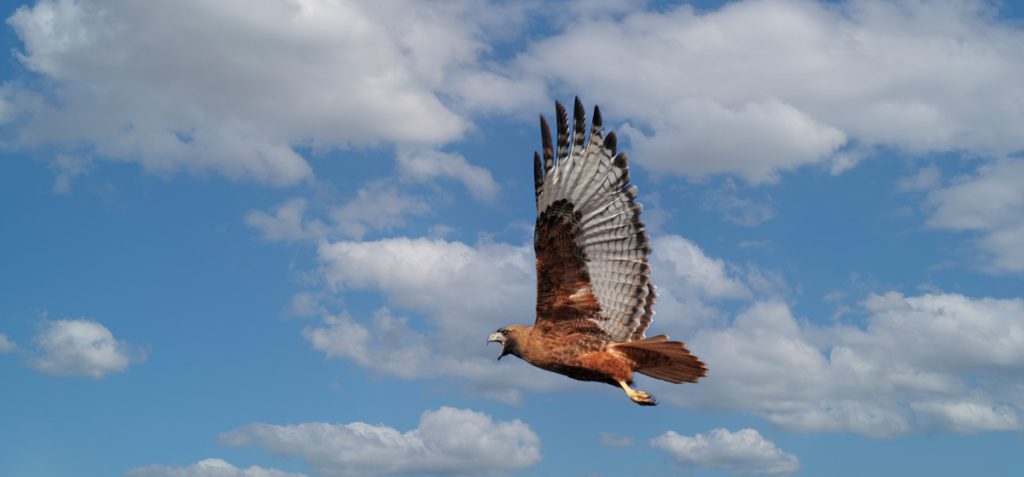
The Red-tailed Hawk (Buteo jamaicensis) owns the skies of New Mexico. Its silhouette—broad wings fringed with sunlight, tail flashing like a rusted blade—cuts across canyon walls and desert mesas with regal indifference. This is no mere bird; it is a winged executioner, a survivor whose strategies have been honed by wind, time, and necessity.
Masters of the Hunt
Red-tails are patient killers. Unlike falcons that strike mid-flight or eagles that rely on brute strength, they practice “still-hunting”—perching motionless for hours on juniper snags or powerline poles, waiting to drop like a feathered stone onto unsuspecting prey. But their most astonishing technique? Snake wrestling.
In the scrublands of the southwest, where rattlesnakes sun themselves on rocks, Red-tails have developed a daring tactic: they pin the snake’s head with one talon to avoid strikes, then crush the skull with the other. Researchers in the Gila Wilderness once documented a hawk dispatching a prairie rattlesnake in under 30 seconds—a ballet of precision and nerve.
Their adaptability shines in other ways, too. In arid regions, they’ve been observed dunking prey in water before eating, possibly to soften tough hides or hydrate their meal. And along New Mexico’s highways, they’ve learned to ride thermals from overpasses, scanning medians for rodents—a behavior that’s earned them the nickname “interstate hawks” among biologists.
New Mexico’s Aerial Icon
From the Rio Grande’s cottonwood bosques to the volcanic escarpments west of Albuquerque, Red-tails thrive where the land opens wide. They nest on cliffs and in towering ponderosas, often reusing the same eyrie for decades, adding sticks each year until the structure becomes a massive, tangled monument.
Recent studies reveal their intelligence: they memorize hunting perches, recognize individual humans who disturb their nests, and even use their tails as decoys during attacks—flaring those rust-red feathers to distract prey from their striking talons.
Feathers and Folklore
To the Diné (Navajo), the Red-tail is a messenger, its cry a signal to pay attention. Warriors once carried its feathers for protection, and its keen vision symbolized foresight. A Zuni proverb captures it best: “The hawk sees farther because it flies higher.”
Even Hollywood pays homage—sort of. That piercing keeeeer! you’ve heard in a hundred movies? It’s always a Red-tail, even when the on-screen bird is an eagle. (The actual bald eagle sounds closer to a seagull.)
A Shadow on the Wind
Next time you’re driving through the high desert, look up. That dark shape circling overhead isn’t just a bird—it’s a thread in the web of this land, a creature that has outlasted droughts, wildfires, and the spread of asphalt. The Red-tailed Hawk doesn’t just survive the modern West; it defines it, a sovereign spirit riding the currents between wilderness and civilization.