

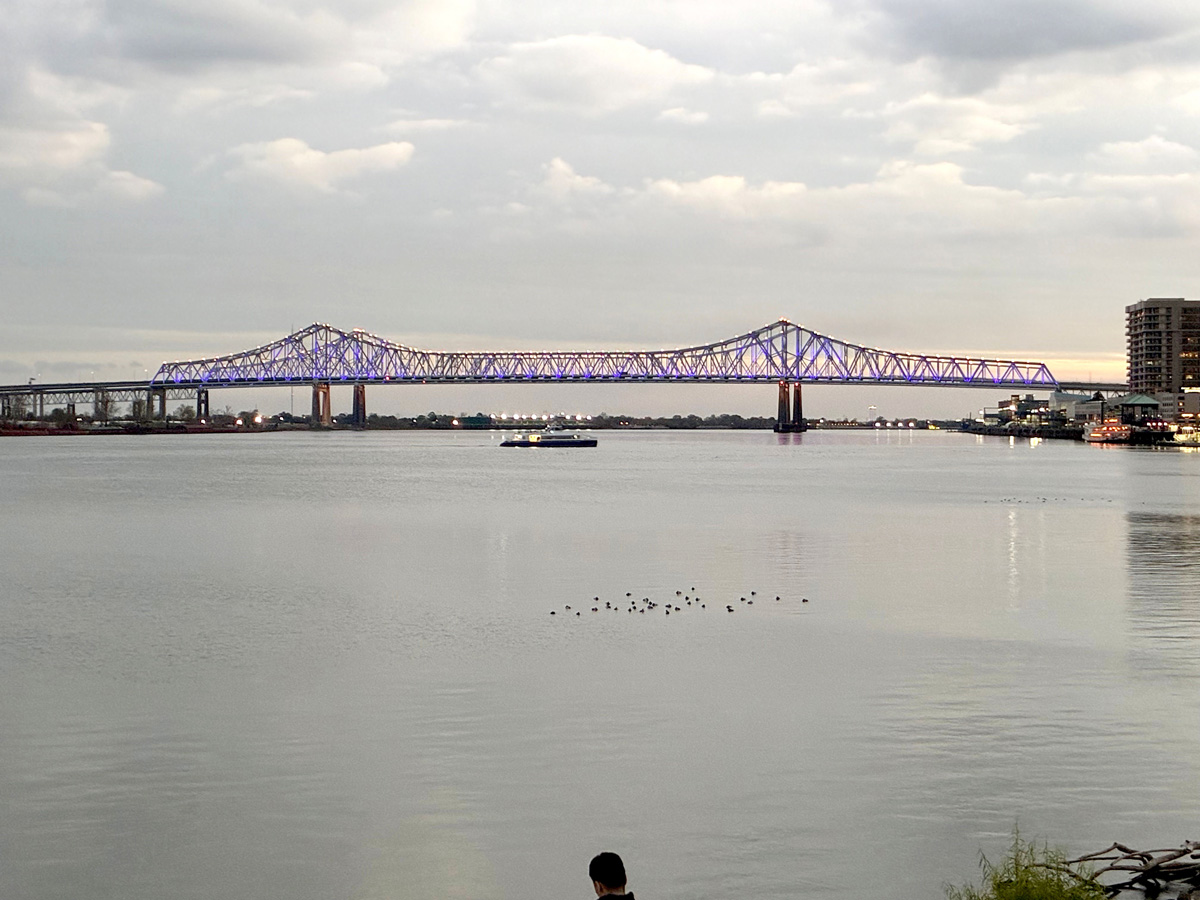
I recently spent a few days at a gathering of water professionals, specifically, people who design and manage the restoration of trout rivers like the Red River. The meeting was in New Orleans, where there are no trout. Our group had come from the Rocky Mountains, where there are many. At first I thought (forgetting for a second that I had never been to New Orleans and really wanted to experience its culture) holding a meeting where there are no trout seems foolish.
Maybe so, but when you think about it for a second, it seems natural to see or, given the Mississippi Rivers other-worldly size, at least imagine where all the water where we live ends up after we restore the tiny streams in our backyards. My fellow attendees came from Montana, Colorado, Utah, Nevada, Arizona, and Nevada. Together with huge rivers like the Ohio in the east, the rivers of the Rocky Mountains and the west contribute generously to the Mississippi and are a big reason it can accommodate ships, barges, and tugboats through hundreds of miles of its downstream length.
The largest watershed in North America, the Mississippi encompasses all or parts of 31 states, capturing approximately 41 percent of the freshwater runoff in the lower 48.
I spent a lot of time in New Orleans trying to figure out what that means. While strolling along the river one day, I estimated the river’s width to be a mile. An enormous ship was chugging upstream at a pace of around 25 miles an hour. As the ship approached a bend in the river, I thought it was moving way too fast to be able to negotiate the turn. But it took the turn like a Ferrari. I wondered how deep the river would have to be for a captain to steer the ship so confidently.
I marveled at the reality that a snowflake landing just one inch east of the top of Bobcat Pass above Red River was destined to flow through New Orleans. It would melt, feed Moreno Creek, which empties into Eagle Nest Lake. From there the snowflake goes down the Cimarron canyon, passes through Cimarron and Springer on its way to the Canadian River, which gets swallowed by the Arkansas River, which gets swallowed by the Mississippi near Little Rock. By the time our snowflake at Bobcat Pass reaches New Orleans, it has traveled over 1,200 miles.
I could have done a similar exercise with the rivers worked on by my colleagues at the meeting, who are dealing with storied rivers like the Platte, originating in Colorado and spilling on the plains of Nebraska on its way to New Orleans. The Yellowstone in Wyoming. The Missouri river in Montana. Their tributaries were born in the mountains, our mountains, joining together as if on a road trip to hear some jazz and eat cajun food.
I do obsess over these things. I like thinking about water’s journey from the headwaters to the sea and the work we make it do along the way. We always talk about what water does for us, less about what we do for water that’s nice. To nourish it, strengthen it, which is extremely important these days. The Red River (arriving at the Gulf of Mexico via the Rio Grande instead of the Mississippi) is a better stream than it was before its restoration. The Cimarron is a better river than it was before it was restored. It’s fun to think that those small projects yielded just a smidgen of cleaner water to make the brown Mississippi a better river too.