

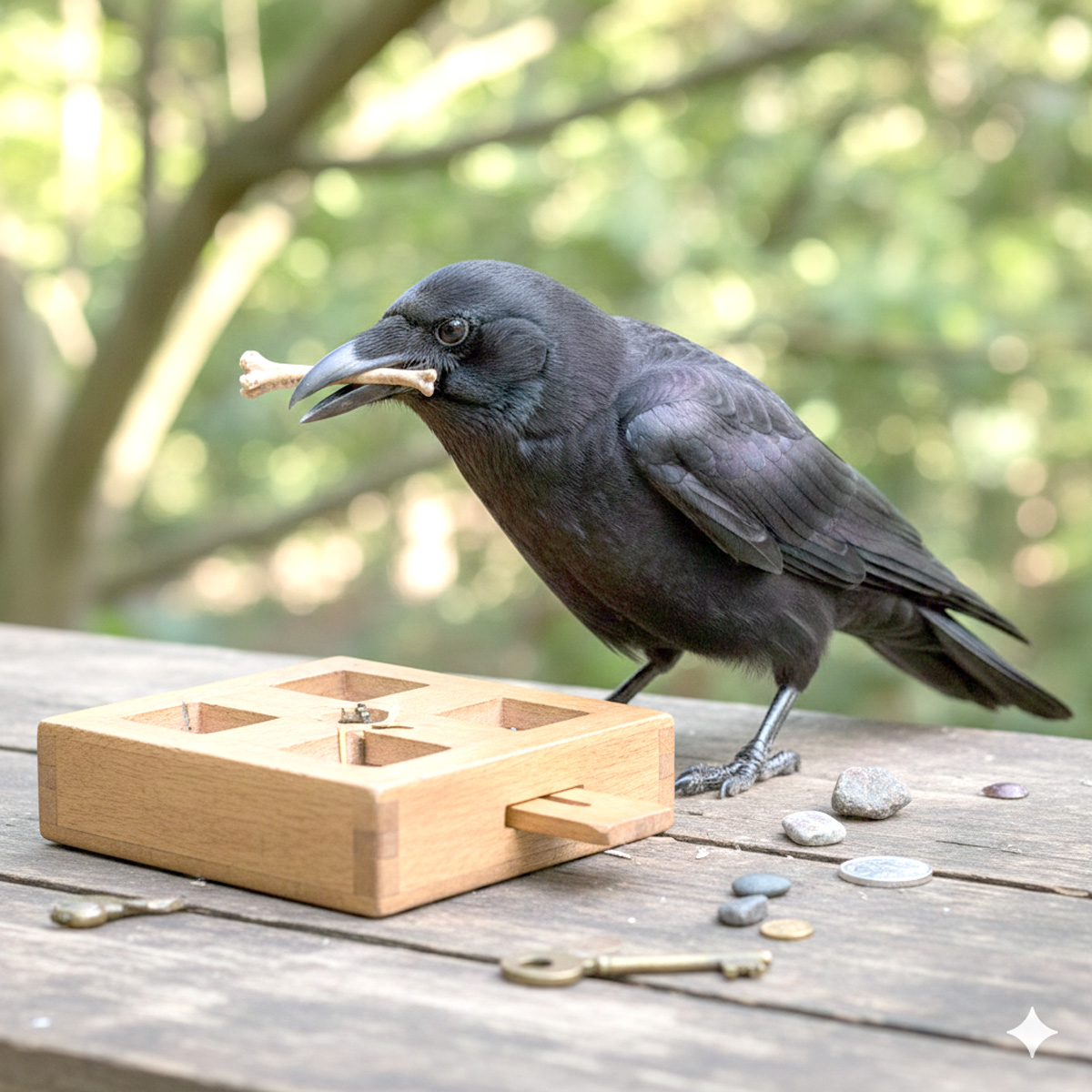

In the cottonwood groves along the Rio Grande and the piñon forests of New Mexico’s high country, a misunderstood genius conducts its daily business. The American crow (Corvus brachyrhynchos) has been maligned as a harbinger of death and dismissed as a scavenger, yet here it remains, 31 million strong across North America, outsmarting humans at every turn.
These glossy black birds, measuring 16 to 21 inches long, possess brains proportionally larger than those of humans. Recent neuroscience reveals why. When a crow encounters one of its dead, the bird’s nidopallium caudolaterale — the avian equivalent of the human prefrontal cortex — activates intensely, functioning as a command center for decision-making.
The Funerals That Teach
Kaeli Swift, an avian behavioral ecologist at the University of Washington, has witnessed hundreds of crow funerals. When a crow discovers a dead companion, it summons others with an urgent alarm call. They gather on branches, fall silent, then erupt into raucous calling for 15 to 20 minutes before dispersing.
Swift’s research shows that crows are not grieving in the human sense; they are learning. The sight of a dead crow activates decision-making centers, turning tragedy into a teachable moment about danger. In experiments, crows remembered human faces associated with dead crows for up to six weeks, dive-bombing those individuals whenever they reappeared. They were conducting forensic analysis, gathering intelligence to survive.
The Gift Economy
The internet delights in stories of crows bringing gifts to humans who feed them — shiny bottle caps or bits of metal. What appears to be gratitude may be more pragmatic. Conservation ecologist John Marzluff refers to this as “gifting,” though the underlying mechanism remains debated.
One explanation is that operant conditioning works both ways. A crow drops an object near a feeding station, and the delighted human puts out extra food. The crow learns that a shiny object results in a larger meal, recognizing and exploiting patterns. This capacity was demonstrated by Josh Klein’s “crow vending machine,” which proved crows can learn multistep processes and recognize currency.
Sacred Keepers of Wisdom
In the pueblos of New Mexico, crows occupy an honored place far removed from European superstition. Pueblo peoples include crow clans, and unlike Western mythology, these birds are considered harbingers of good fortune.
In Cherokee tradition, the crow is known as Koga Nvwati, or crow medicine — the ability to make decisions and embrace change. Unlike European tales of cursed birds, many Indigenous stories celebrate the crow’s cleverness. These are birds that brought fire to freezing people and taught lessons about respecting animals.
Thriving in Our World
From a conservation standpoint, the American crow represents a rare success story. The species has not only survived human persecution but thrived alongside it. The secret lies in adaptability. Crows exploit nearly every habitat humans create, from farmland and city parks to suburban backyards.
Walk through Old Town Albuquerque at dusk and crows may be seen streaming toward communal roosts against the pink glow of the Sandia Mountains. These birds are neither omens nor pests. They are neighbors, sharing the landscape with a sophistication humans are only beginning to understand.